

Organizations invest heavily in training, whether that’s leadership development, compliance training, technical upskilling, or onboarding. But one question consistently follows every initiative: Did the training actually work?
Training evaluation provides the answer. It helps learning and development (L&D) teams determine whether programs improve knowledge, change behavior, and deliver measurable business value.
Without a clear evaluation strategy, training risks becoming a cost center rather than a strategic investment. Leaders want to see evidence: improvements in performance, stronger engagement, faster skill acquisition, or financial returns.
In this guide, you’ll learn
- What training evaluation is and why it matters
- Where evaluation fits in the learning cycle
- The most widely used training evaluation models
- How to design a realistic evaluation plan
- What methods and tools to use to collect meaningful data
By the end, you’ll have a practical framework for evaluating training programs in a way that demonstrates impact, improves learning design, and builds credibility with leadership.
TL;DR
- Training evaluation measures the effectiveness and impact of learning programs.
- The most widely used frameworks include Kirkpatrick, Phillips ROI, CIPP, and the Success Case method.
- Evaluation should happen before, during, and after training, not just at the end.
- Effective evaluation plans start with business goals, then define metrics, baselines, and data sources.
- Organizations typically collect data through surveys, assessments, manager feedback, and performance metrics.
- The goal of training evaluation is to improve programs and align L&D with business results.
What Is Training Evaluation and Why It Matters
Training evaluation is the process of assessing the effectiveness, impact, and value of learning programs.
At its core, evaluation answers these three key questions:
- Did learners gain knowledge or skills?
- Did those skills change workplace behavior?
- Did the change improve business outcomes?
For L&D teams, training evaluation serves several important purposes.
- Proving the value of learning programs. Executives want evidence that training investments deliver measurable results. Evaluation provides data that connects learning initiatives to outcomes like productivity, retention, or customer satisfaction.
- Improving training design. Evaluation highlights what worked and what didn’t. This feedback helps teams refine content, delivery methods, and learning experiences.
- Supporting strategic decisions. Evaluation insights help organizations decide where to invest future training resources. Examples:
- Which programs should scale?
- Which require redesign?
- Which should be retired?
- Aligning learning with business goals. When evaluation focuses on performance metrics and organizational outcomes, L&D becomes a strategic partner rather than a support function.
For deeper insight into connecting learning with business outcomes, see our guide on aligning L&D with business KPIs.
Where Training Evaluation Fits in the Learning Cycle
One of the most common misconceptions is that evaluation happens after training ends. But in reality, effective evaluation spans the entire learning lifecycle. Think of evaluation as an ongoing feedback loop that informs program design, delivery, and improvement.
Before Training: Define the Problem and Outcomes
Evaluation begins during program planning. At this stage, teams identify
- The business challenge the training will address
- The desired performance outcomes
- The metrics that will measure success
Examples:
- Reduce safety incidents by 20%
- Improve new hire productivity within 90 days
- Increase sales conversion rates
Defining these outcomes early ensures training initiatives stay aligned with organizational priorities.
During Training: Track Engagement and Learning
While training is in progress, evaluation focuses on learner experience and knowledge acquisition.
Examples:
- Engagement and participation
- Assessment scores
- Knowledge retention
- Completion rates
These insights help instructors or program owners adjust delivery if needed.
After Training: Measure Behavior and Results
The most valuable insights often come after learners return to the workplace. At this stage, organizations evaluate
- Behavior changes on the job
- Manager observations
- Performance improvements
- Business outcomes
This phase connects learning activities to real-world impact.
If you’re exploring how evaluation ties into broader measurement strategies, check out our article about learning measurement.
Core Training Evaluation Models and When to Use Them
Various frameworks help organizations structure their evaluation approach.
- Kirkpatrick’s Four Levels
- Phillips ROI Model
- CIPP Model
- Brinkerhoff Success Case Method
Each model provides a different perspective on measuring training effectiveness. And understanding them helps L&D leaders choose the right approach for their goals and resources.
Kirkpatrick Model: Four Levels of Training Evaluation
The Kirkpatrick Model evaluates learning programs across four levels of impact.
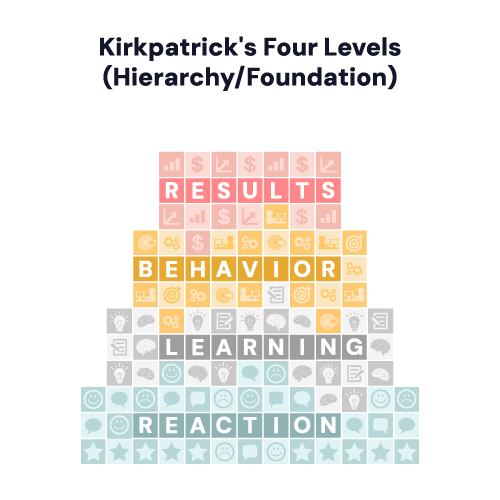
Level 1: Reaction
This level measures learners’ satisfaction with the training experience by asking questions like
- Did participants find the training useful?
- Was the content relevant?
- Was the instructor effective?
Data sources often include
- Post-training surveys
- Feedback forms
- Course ratings
For more on gathering effective learner feedback, read our article about feedback for training.
Level 2: Learning
This level evaluates knowledge or skill acquisition through
- Knowledge tests
- Skill demonstrations
- Pre- and post-training assessments
The goal is to confirm that learners actually gained the intended competencies.
Level 3: Behavior
Level 3 examines whether learners apply new skills on the job, and it does so through
- Manager observations
- Performance reviews
- On-the-job assessments
- 360-degree feedback
This level is critical because learning only creates value if it changes behavior.
Level 4: Results
The final level measures organizational impact through
- Increased sales
- Reduced errors
- Improved customer satisfaction
- Faster onboarding
- Higher retention
While many organizations measure levels 1 and 2, levels 3 and 4 provide the strongest evidence of training effectiveness.
Phillips ROI Model: Adding Financial Return
The Phillips ROI model builds on the Kirkpatrick framework by adding a fifth level: return on investment (ROI). It translates training outcomes into financial value.
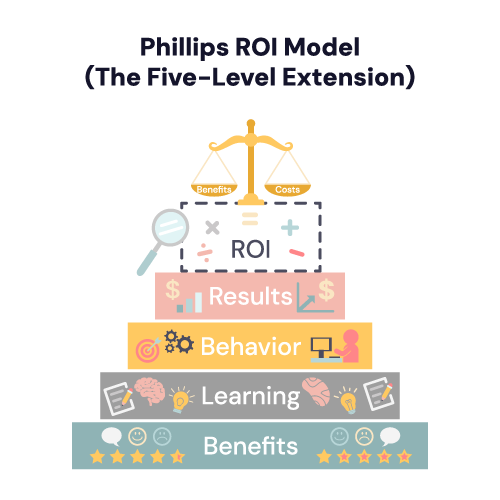
The goal is to compare the financial benefits of training with the cost of delivering it. And the typical formula is:
ROI (%) = (Program Benefits − Program Costs) ÷ Program Costs × 100
Benefits include
- Increased revenue
- Reduced operational costs
- Lower turnover
- Productivity improvements
For instance, a leadership program that improves manager retention could reduce hiring costs.
If you’re evaluating digital training programs, this guide explains how to measure and optimize eLearning ROI.
While powerful, the Phillips model requires strong data collection and analytical capabilities.
CIPP Model: Context, Input, Process, Product
CIPP stands for context, input, process, and product, and the model takes a broader evaluation perspective. Instead of focusing only on outcomes, it evaluates program design, implementation, and impact.
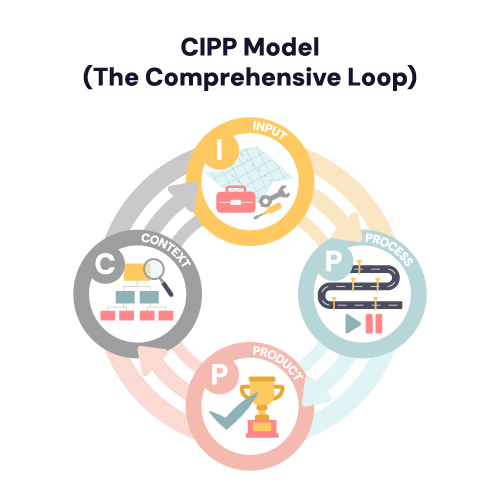
Context Evaluation
This step identifies the needs or problems that the training must address, such as
- Existing performance gaps
- Skill development needs across the company
Input Evaluation
This stage assesses the training strategy and resources by examining
- Learning design
- Technology platforms
- Budget and resources
The goal is to determine whether the planned approach is the best solution.
Process Evaluation
Process evaluation monitors the implementation of the training. And it answers questions like
- Is the program being delivered as designed?
- Are learners engaging with the content?
Product Evaluation
Finally, product evaluation measures the outcomes and results of the program, which may include learning gains, behavior changes, or business results.
The CIPP model is particularly useful for large or complex programs, such as leadership academies or organization-wide initiatives.
Brinkerhoff Success Case Method
The Success Case Method focuses on identifying the most successful examples of training impact. But instead of measuring every participant equally, it investigates extreme cases.
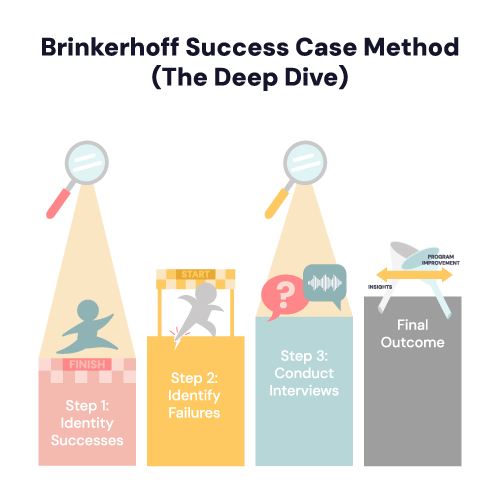
The method typically follows these steps:
- Identify participants who achieved exceptional results
- Identify participants who saw little or no improvement
- Conduct interviews and case studies
- Determine what factors contributed to success or failure
This approach provides rich qualitative insights that help organizations understand what drives effective learning. And it’s particularly useful when
- Training outcomes vary widely
- Organizations want to understand success factors
- Data is limited, but stories are valuable
Other Training Evaluation Models
While the four frameworks above dominate the field, several additional models are worth noting.
Anderson Model
The Anderson model emphasizes alignment between learning strategy and organizational goals. It encourages organizations to evaluate training based on how well it supports business priorities.
CIRO Model
The CIRO model evaluates programs across four stages:
- Context
- Input
- Reaction
- Outcome
It’s similar to Kirkpatrick but includes more focus on program planning.
Dreyfus Model of Skill Acquisition
The Dreyfus model tracks how learners progress through skill mastery levels, from beginner to expert. It’s often used in professional development and technical training programs.
While these models provide useful perspectives, most organizations rely primarily on Kirkpatrick, Phillips ROI, CIPP, or Success Case methods.
How to Choose a Training Evaluation Model for Your Program
Selecting the right evaluation model depends on several factors. But the quick checklist below is perfect for guiding the decision.
Consider the Program’s Strategic Importance
High-impact programs—such as leadership development or enterprise transformation—often require deeper evaluation, including ROI analysis.
Assess Available Data
Some models require detailed performance metrics or financial analysis. But if your organization lacks those data sources, simpler models may be more practical.
Evaluate Available Resources
Comprehensive evaluation requires time, expertise, and tools. So, choose a model that matches your organization’s capacity.
Start Simple and Scale
Many organizations begin with the Kirkpatrick model and gradually add additional methods as their measurement maturity grows.
How to Design a Realistic Training Evaluation Plan
Choosing a model is only the first step. The real challenge lies in creating a practical evaluation plan that teams can execute. Follow the steps below to design one.
Start from the Business Question
Effective evaluation begins with a clear problem statement. And to find yours, ask
- What performance issue are we solving?
- What outcome would indicate success?
- How will leaders judge the program’s value?
Examples of answers include:
- Reduce workplace safety incidents by 15%
- Increase customer satisfaction scores
- Improve first-year manager retention
- Reduce time-to-competency for new hires
Starting with business questions ensures evaluation focuses on real organizational priorities.
Map the Model to Levels of Data You Will Collect
Next, determine which levels of evaluation are realistic. For instance, if you chose the Kirkpatrick model, here’s an example of such mapping:
- Level 1 → surveys and feedback
- Level 2 → knowledge assessments
- Level 3 → manager observation and performance metrics
- Level 4 → business outcomes
Mapping data sources early prevents evaluation plans from becoming unrealistic.
Define Metrics, Baselines, and Targets
Metrics provide the foundation for meaningful evaluation. So, for each metric, identify
- The baseline—or current performance level
- The target—or expected improvement
- And the measurement method—or how the data will be collected
Here’s an example:
- Goal: to improve onboarding effectiveness
- Baseline: new hire productivity reached in 6 months
- Target: reach productivity in 4 months
- Measurement: manager assessments and productivity metrics
Clear metrics make the evaluation objective and credible.
Plan Data Collection, Roles, and Timelines
Evaluation requires coordination across multiple stakeholders like
- L&D teams collecting learning data
- HR teams tracking workforce metrics
- Managers providing behavioral observations
- Operations leaders sharing performance KPIs
So, with the needs of each role in mind, establish timelines for when each data source will be collected. Here’s an example:
- Immediately after training: surveys
- 30–60 days later: behavior change feedback
- 6 months later: performance outcomes
Close the Loop by Using Insights to Improve Programs
Evaluation only creates value when insights drive improvement. That’s why after collecting data, L&D teams must analyze results.
- What aspects of the program worked well?
- Where did learners struggle?
- What factors influenced successful outcomes?
These insights help refine future training initiatives and strengthen the company’s broader learning measurement strategy.
Training Evaluation Methods and Tools: What Data You Can Collect
Evaluation models provide structure, but organizations still need methods and tools for collecting data, such as the ones we curated for you (below).
Surveys and Feedback Forms
Post-training surveys capture learner reactions and perceived value. They give you metrics like
- Course satisfaction
- Content relevance
- Instructor effectiveness
- Likelihood to recommend
While useful, surveys alone can’t measure the impact of training.
Tests and Assessments
Assessments like these evaluate knowledge acquisition
- Quizzes
- Simulations
- Scenario-based assessments
- Skill demonstrations
Comparing pre- and post-training scores provides clear evidence of learning.
On-the-Job Observation and Manager Feedback
Managers play a critical role in evaluating behavioral change through
- Observation checklists
- Performance evaluations
- Coaching feedback
- Peer reviews
These insights help determine whether learning translates into workplace performance.
Performance Data and KPIs
Business metrics provide the strongest evidence of training impact, such as
- Sales growth
- Customer satisfaction scores
- Safety incidents
- Productivity measures
- Employee retention
Connecting learning programs to these metrics strengthens the strategic role of L&D.
Qualitative Methods
Interviews and focus groups provide deeper insight into learner experiences. They’re particularly valuable for
- Leadership programs
- Cultural initiatives
- Complex organizational change efforts
Qualitative insights often reveal why programs succeed or fail.
Turn Training Evaluation Into a Learning Advantage with ELM
When done well, training evaluation goes beyond reporting and transforms learning programs into a strategic driver of organizational performance.
By applying proven frameworks like Kirkpatrick, Phillips ROI, CIPP, or the Success Case method, L&D leaders can
- Demonstrate the value of training investments
- Identify opportunities to improve learning programs
- Align learning initiatives with business outcomes
However, building effective evaluation strategies requires the right expertise, tools, and learning design approach.
But we help organizations develop data-driven learning programs that connect training initiatives to measurable performance improvements. From learning strategy and instructional design to measurement frameworks and analytics, our team helps organizations create learning experiences that deliver real business impact.
FAQs About Training Evaluation
What’s the difference between training evaluation and training effectiveness?
Training evaluation is the process of collecting and analyzing data about learning programs. On the other hand, training effectiveness refers to how well the program achieves its intended outcomes.
Evaluation helps determine whether training is effective.
Which training evaluation model should organizations start with?
Most organizations begin with the Kirkpatrick model because it is simple, widely understood, and adaptable. But as evaluation maturity grows, organizations may incorporate additional approaches like ROI analysis or Success Case studies.
How often should you evaluate a training program?
Evaluation should happen at multiple stages.
- Immediately after training for learner feedback
- Several weeks later, measure behavior change
- Several months later, to assess business impact
Ongoing evaluation ensures programs remain aligned with organizational goals.
Can small organizations use training evaluation models without a data team?
Yes. Many evaluation methods require minimal resources, so small organizations can start with
- Post-training surveys
- Knowledge assessments
- Manager feedback
- Basic performance metrics
Even simple evaluation approaches can provide valuable insights that improve training programs over time.